Portfolio sample

Process Explainer: How Scotch Whisky is Made

Sample project overview for a short, self-directed process explainer module that walks adult learners through how Scotch whisky is made, step by step.

Case study

The challenge

Whisky production is often described in dense, expert-level language that assumes background knowledge of distilling, chemistry, and regulations. For adult learners and non-traditional students, this can make it hard to see the big picture: how barley becomes Scotch, which stages matter most, and what the law actually requires.
The response

This project explores how to turn that complex process into a clear, accessible explainer that respects real constraints on attention, access, and prior knowledge. The module focuses on the core production stages and regulatory basics, using plain language and simple visuals.

Audience

  • Hospitality staff who need a clear overview.
  • New distillery hires without a science background.
  • Adult enthusiasts who want structured, non-technical context.

Learning objectives

  • Identify the core ingredients used in Scotch whisky production.
  • Describe the main stages of malt whisky production: malting, mashing, fermentation, distillation, and maturation.
  • Explain how single malt differs from single grain and blended Scotch categories.
  • Explain the regulatory requirements for a distilled spirit to qualify to be labeled as Scotch whisky.

Accessibility choices

Accessibility decisions include avoiding drag-and-drop interactions, keeping colour and contrast WCAG-aware, and ensuring all controls and graphics have clear labels or captions.

Process explainer page map

This project can be laid out on a single html page, or in using a course layout similar to those commonly used in Articulate Rise 360.

Section Title Purpose Primary content / visual
1 The making of Scotch whisky Introduce topic and relevance. Title, one-sentence overview, and quick process preview with an original line-art hero graphic.
2 What makes Scotch Scotch? Establish legal and production basics. Scotland, ingredients, and maturation basics presented in plain language, supported by a simple icon row or definition card.
3 Process overview Give the full sequence before detail. High-level flow from grain to cask, shown in a horizontal or stacked process diagram.
4 Malting Explain barley preparation. Steeping, germination, and kilning, supported by a barley/kiln icon or mini diagram.
5 Mashing Explain sugar extraction. Grist, mash tun, and wort, supported by a mash tun icon or vessel diagram.
6 Fermentation Show alcohol creation. Yeast, washbacks, and wash, supported by a simple washback diagram.
7 Distillation Explain spirit concentration. Pot stills for malt whisky, supported by a simplified still diagram.
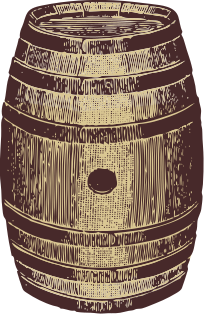
8 Maturation Explain oak casks and aging. Oak casks, time, and flavour development, supported by a barrel/cask icon or maturation graphic.
9 Categories Compare major Scotch types. Single malt, single grain, and blends, shown via a comparison table or cards.

Content constraints

  • Keep learner-facing copy concise and plain-language.
  • Avoid tasting-note digressions unless they support a learning objective.
  • Do not include brand-specific product claims unless they are necessary and well sourced.
  • Prefer process understanding over whisky tourism or lifestyle framing.

Section mockup

This section presents a sample maturation-screen and label-reading scenario to demonstrate how the Scotch whisky process explainer could be built with clear, accessible content and licensing-safe visuals.

Section 8 of 9
Maturation: Oak casks and aging

From clear spirit to mature Scotch

Why maturation matters

After distillation, clear “new make spirit” is filled into oak casks in Scotland and left to mature for at least three years before it can legally be called Scotch whisky.

During this time, the spirit slowly interacts with the oak and the surrounding air. Harsh notes are softened, flavours and colour from the wood are added, and the whisky’s character gradually develops.

A small portion of the liquid evaporates each year (often called the “angel’s share”), and many whiskies are matured well beyond the three-year minimum for greater depth and complexity.

Section 8 of 9
How casks shape flavour

From storage to transformation

What casks do over time

When new make spirit first goes into an oak cask, it is clear, intense, and still closely tied to the distillation process. Over the years, the cask and the air around it steadily change the spirit’s flavour, aroma, and colour.

These changes are often grouped into three linked effects:

  • Additive: The spirit absorbs flavour and colour from the oak and any previous contents of the cask, gaining vanilla notes, gentle sweetness, and deeper hue.
  • Subtractive: The charred inner layer of the cask acts as a natural filter, reducing harsh, sulphury or “metallic” notes and helping the whisky become smoother and more approachable.
  • Interactive: As air slowly moves through the oak, oxygen and time help create new flavour compounds, so the distillery’s character and the cask’s influence blend into more complex aromas.
Section 8 of 9
Reading a maturation claim

Scenario: Understanding age statements

Which age matters most?

You see a bottle labelled “Blended Scotch Whisky – aged 12 years” with a note on the back that the blend includes whiskies matured for 8, 12, and 18 years.

Based on what you know about maturation rules for Scotch, answer the following:

  1. Part 1 – General rule: In a legally compliant Scotch whisky, what does a “12 years” age statement on the label tell you about the whisky in the bottle?

  2. Part 2 – This example: If the blend in this example really includes whiskies matured for 8, 12, and 18 years, what is wrong with the “aged 12 years” label, and which age would most accurately describe the whisky in the bottle?

Design notes: In the interactive version of this screen, learners could answer Part 1 using radio buttons that focus on the rule that Scotch must be matured in oak casks in Scotland for at least three years and that the age statement reflects the youngest whisky in the bottle. Part 2 then asks them to apply that rule to a specific blend, recognizing that any component younger than 12 years would make the “aged 12 years” claim incorrect and that the correct age statement would be based on the youngest whisky in the blend.

Sample interactive learning checks

These examples show how the process explainer could be designed to check understanding of Scotch regulations and core process stages using keyboard- and screen-reader-friendly interactions.

Multiple-choice: Legal definition of Scotch whisky

Which of the following best describes the basic legal definition of Scotch whisky?

Choose the best definition of Scotch whisky

Design note: Single-select radio buttons with an explicit legend make the item screen-reader and keyboard friendly while checking recall of core regulatory elements (location, ingredients, and minimum maturation time).

True/false: Maturation outside Scotland

True or false: Whisky distilled in Scotland but matured in oak casks outside Scotland can still be labelled as Scotch whisky.

True or false question about Scotch maturation rules

Design note: This item surfaces a common misconception about Scotch regulations and uses a simple true/false radio pair with clear labelling for accessibility.

Matching: Process stages and descriptions

Match each stage in the Scotch production process to the description that fits it. For each stage, type the letter (A–G) of the matching response in the box.

Match process stages to descriptions by entering response letters

Stages


Response options

  • A – Steeping barley, allowing it to germinate, and then drying it in a kiln to prepare the grain for sugar conversion.
  • B – Mixing milled malt with hot water in a mash tun to extract fermentable sugars and produce wort.
  • C – Adding yeast to wort in washbacks so sugars are turned into alcohol and carbon dioxide, producing wash.
  • D – Distilling wash, usually twice, in copper pot stills to produce low wines and then new make spirit.
  • E – Filling spirit into oak casks and leaving it to age for at least the legal minimum period, allowing flavour and colour to develop.
  • F – Mixing mature whisky from different distilleries to create a consistent flavour profile for a brand.
  • G – Diluting bottled whisky with water, ice, or mixers to suit personal taste.

Design note: Learners enter one letter (A–G) for each stage. Five responses correctly match the core production stages, while two responses are plausible but incorrect options that check deeper understanding of where blending and serving fit into the overall process.